FITS Technology Looks to Divest Its
Foamed In Situ Thermoplastic Sandwich Panel Systems
The Dutch company is seeking a partner within the composites or civil aerospace space to take on and scale its aerospace interiors-focused product and/or its automotive product.
 |
Edited by: GRACE STUBBINS
|
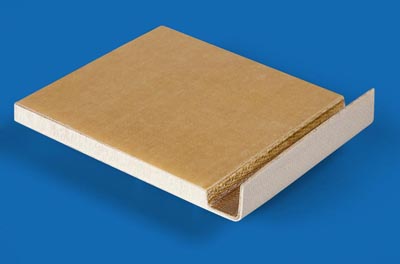
FITS Technology (Driebergen, The Netherlands), developer of the globally patented FITS AIR (TRL 5-6) thermoplastic composite (TPC) sandwich panel system and an accompanying automated thermoformable application process, is seeking a partner within the composites industry to take on and advance its technologies. The company is looking to transfer this core product line to an organization positioned to bring them to broader commercial scale.
“Honeycomb has been a phenomenally useful product over many decades, but it has been generally accepted that it reached many of its technical limitations long ago,” says Martin Th. de Groot, CEO and founder of FITS Technology. He refers to phenolic’s health and environmental issues, as well as the chemical waste its parts produce. “Thermoplastics are very often cited as the likely replacement.”
Featured Content
Such a solution was first invented and marketed more than two decades ago via FITS AIR — “by two individuals attending the University Research Department in Holland, without significant budgets and without the backing of any large corporation,” notes de Groot — which the company has been striving to highlight and implement within industry.
FITS AIR is built around a polyetherimide (PEI) core with vertical oriented foam cells (high compression strength) and fiber-reinforced PEI facings, designed as an alternative to Nomex honeycomb construction used in aircraft and train interiors. The panels are manufactured in a press through an in situ foaming process, using an acetone-based physical blowing agent which is swollen into an extruded PEI film. This film is placed between two fiber-reinforced PEI facings in a heated press, the stack-up is heated, and the press is opened and the foam is formed with vertical cells between the fiber-reinforced PEI facings. After cooling of the press plates, the acetone is later removed through an oven-drying step.
Airbus and Boeing have both tested FITS AIR panels and confirmed compliance with FAA fire, smoke and toxicity standards. The panels can significantly cut part weight and manufacturing time versus traditional Nomex assemblies — largely by eliminating hand labor-intensive potting, filling and curing steps. Target applications include galleys, sidewalls, OHSC, floor panels, lavatory components and seat parts.
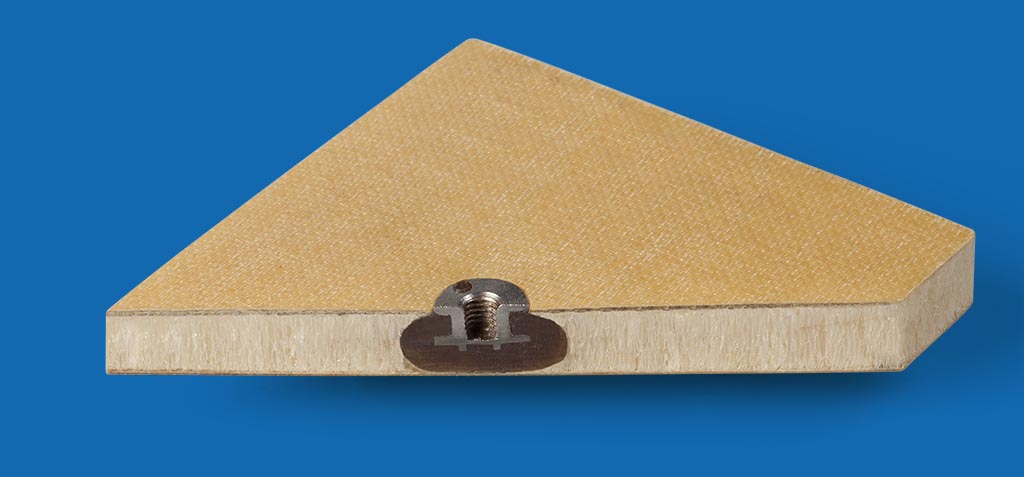
“Our product offers lower part weight, greater design flexibility much lower part manufacturing costs and optimal physical properties [than other offerings],” de Groot states, which has also bee confirmed by AC manufacturers.
The company is also seeking a partner for its globally patented FITS BASE (TRL 2-3) TPC sandwich panel system. FITS BASE is built around a polypropylene (PP) core with vertical-oriented foam cells (high compression strength) and fiber-reinforced PP facings, designed as an alternative to tubular and folded honeycomb constructions used in automotive and many other markets. The panels can be manufactured in a press or continuously through an in situ foaming process using a chemical blowing agent.
FITS Technology is seeking an entrepreneurial business of scale connected to the composites, automotive or civil aerospace industries that is interested in securing FITS AIR for civil aircraft interiors and/or FITS BASE for automotive and other markets.
“Our question to the market is: Is somebody else prepared to take on the potential future of lower-weight transportation — FITS AIR for commercial aircraft interiors, and FITS BASE for automotive and other transport markets?” de Groot poses.
Do you represent that company? Please reach out to Martin Th. de Groot at martin@fits-technology.com or Rolf van Woerkom at rolf@fits-technology.com.